
AI agents are about to touch every live database in production.
Not in a demo. Not in a sandbox. In your database. Right now. Under real concurrency, real retries, real race conditions and most teams have no idea what’s actually happening when they do.
The question isn’t whether AI agents will write to your data. They already are.
The question is: does your infrastructure deserve that level of trust?
The Problem Nobody Is Solving
Here’s what actually happens when AI agents touch live data at scale.
Your agent reads a document. While it’s thinking calling a model, waiting on inference another process updates that same document. The agent finishes, writes back its output. It just overwrote live data with output generated from a stale snapshot. No error. No warning. Clean 200 OK.
That’s not a prompt engineering problem. That’s a concurrency problem. And every enrichment pipeline built on top of a polling script or a naive updateOne is exposed to it.
Then there’s replay. Retries happen. Networks fail. Events arrive twice. Does your pipeline write twice? Does it know the difference between a genuine new event and a re-delivered duplicate? Most don’t.
And loops. The agent writes back to the collection it’s watching. It triggers itself. Again. And again. You’re watching your API costs climb in real time and there’s no circuit to break it.
These aren’t edge cases. These are the default failure modes of AI agents on operational databases.
MongoClaw was built to mitigate these failure modes with explicit runtime controls and observable outcomes.
Not a Tool. A Runtime.
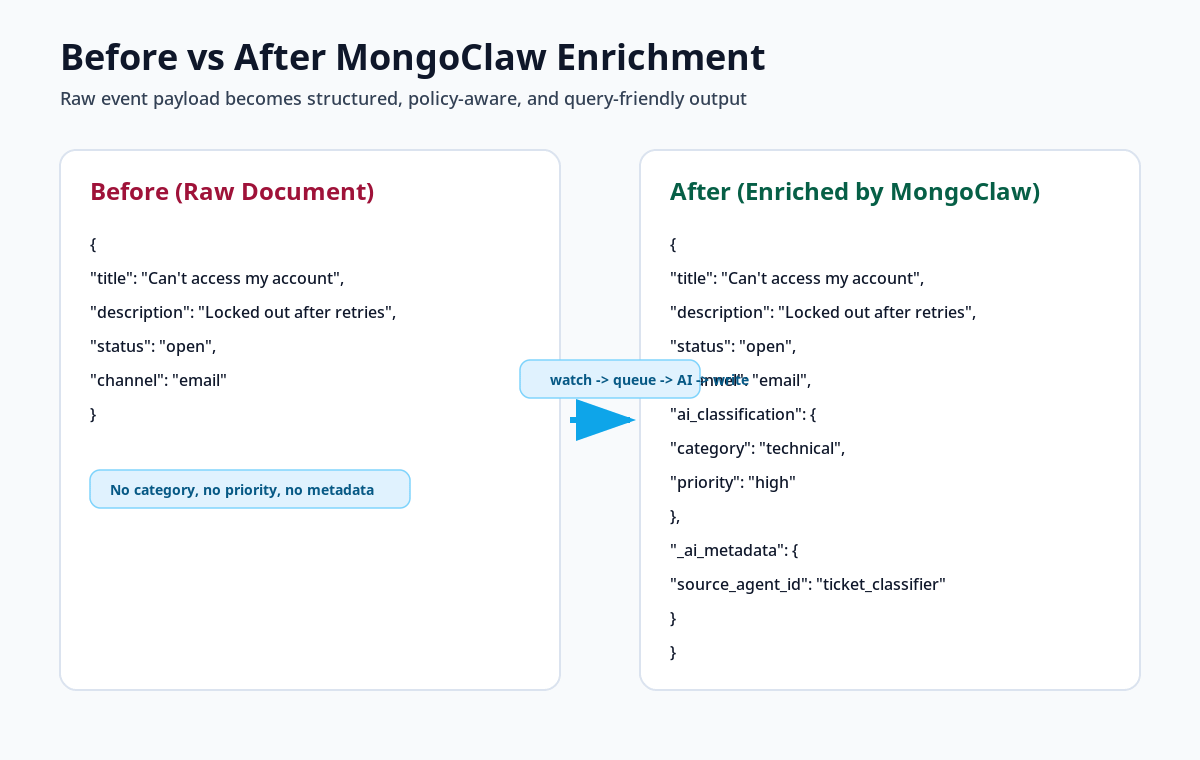
MongoClaw is an event-driven mutation runtime for MongoDB.
That language is deliberate. Not an enrichment helper. Not a wrapper around an API call. A runtime with production-oriented controls for AI-driven mutations: strict consistency modes, idempotency safeguards, policy enforcement, and full execution observability.
It ingests MongoDB change streams, manages async inference execution, enforces write-time integrity checks, applies policy governance before any mutation lands, protects against replay and loops, and emits audit-grade execution records for every operation.
One YAML declaration enables the core safety controls needed for production-oriented AI mutation workflows.
The Invention: Write-Time Integrity Verification
This is the mechanism that makes MongoClaw different from everything else on the market.
When MongoClaw dispatches work to an AI agent, it captures the source record’s version and content hash at the moment of dispatch. That snapshot travels with the work item through the entire async pipeline.
When the inference completes and the result is ready to write MongoClaw doesn’t just write it. It issues a conditional update that only succeeds if the source record still matches the captured snapshot. Version unchanged. Hash unchanged. Then and only then does the mutation land.
If the document changed while the AI agent was thinking? Write suppressed. The stale mutation never touches your database. The outcome is logged, classified, and auditable. strict_version_conflict. hash_conflict. Exact suppression reason. Persisted.
This is not optimistic concurrency control bolted on as an afterthought. It is the write path. Every AI agent mutation, every time, enforced at the database level.
t0: Document read → version=7, hash=abc123 captured at dispatch
t0→t1: AI agent inference runs (unbounded latency)
t1: User updates document → version becomes 8
t1: AI agent result arrives → conditional write checks version=7
t1: MISMATCH → write suppressed, reason='strict_version_conflict' logged
Your live data is protected. Always.
Idempotency That Actually Works
Retries are not bugs. They are features of reliable distributed systems. But retries mean the same event can arrive twice and naive pipelines write twice.
MongoClaw derives an idempotency key from the source record context and tracks completion state persistently. Before any mutation lands, it checks: has this exact logical operation already completed? If yes suppressed. Logged. Returned with lifecycle_state: skipped_idempotent.
This protection applies across all five write strategies merge, replace, append, nested, target_field. It is not a layer you opt into. It is part of the write path.
Networks can fail. Events can replay. Queues can redeliver. MongoClaw provides at-least-once processing with idempotency-based duplicate suppression on the write path.
Policy Governance. In the Execution Path. Not Around It.
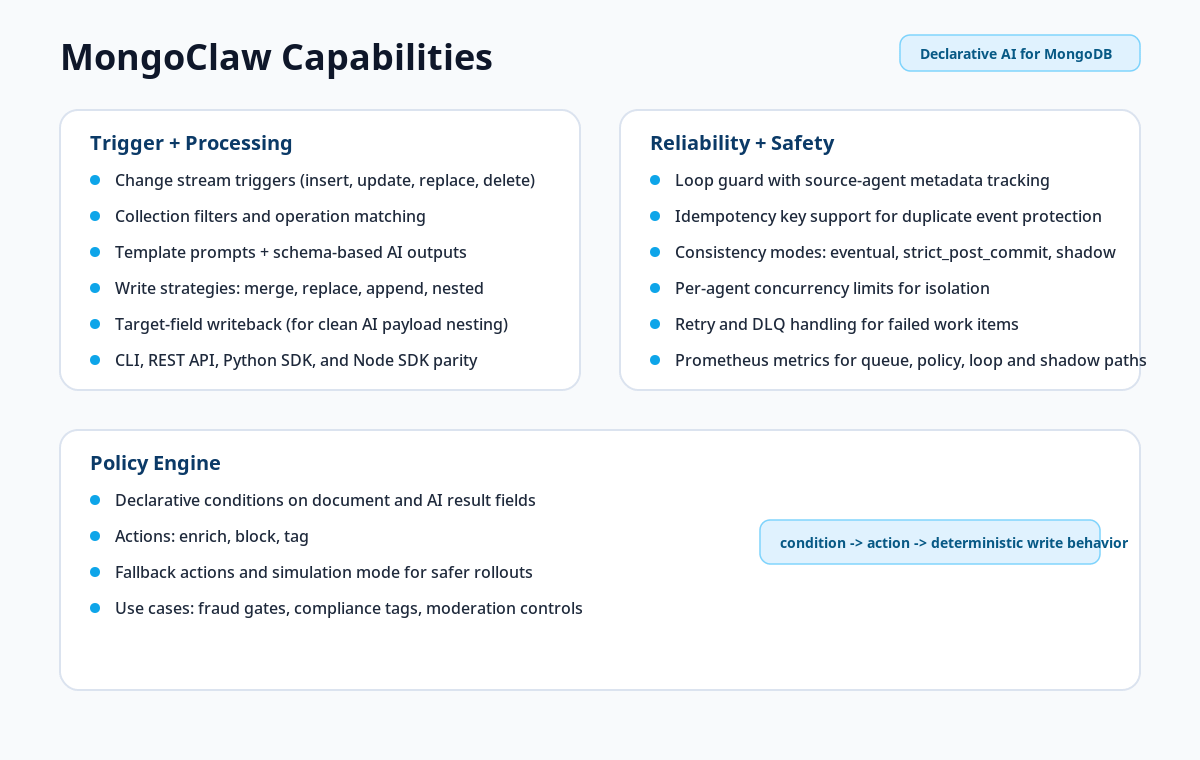
Every other governance approach patches rules around the edges. Input filters. Output validators. Monitoring dashboards. They tell you what happened. They don’t stop it.
MongoClaw puts policy inside the execution path after inference, before mutation, evaluated over both the source record and the AI agent result.
policy:
  condition: result.risk_score > 0.8
  action: block
  fallback_action: enrich
Three enforcement actions:
enrich write proceeds normally. block mutation suppressed. Decision logged with full context. tag AI agent output written as a tag field. Original record untouched.
And simulation_mode the policy evaluates, the decision is logged, nothing is written. Deploy new governance rules in dry-run mode. See every decision before it has real consequences. Ship with confidence.
This is AI agent governance as infrastructure not as compliance theatre.
The Execution Control Plane
Every AI agent operation in MongoClaw produces an audit-grade execution record. Not a log line. A structured, queryable record.
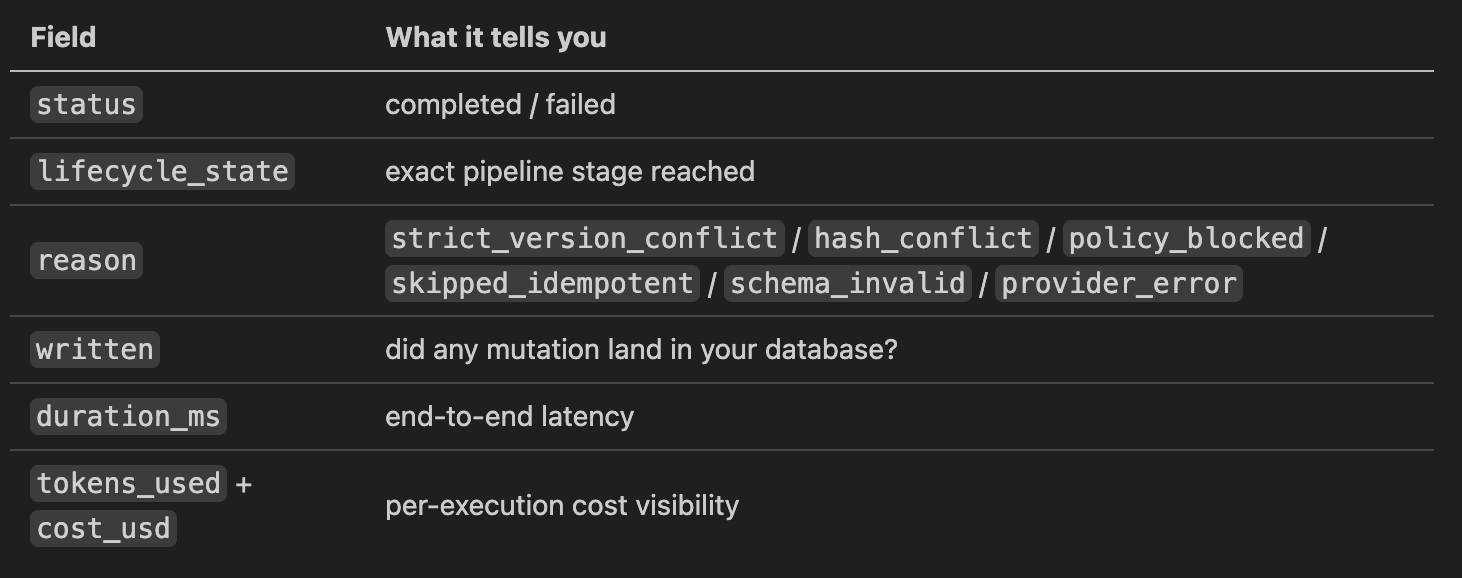
Query them via REST API. Stream them to your SIEM. Scrape them from /metrics. Present them to your compliance team.
When an incident happens and incidents always happen you do not debug from logs. You query execution records. Version conflict? Hash mismatch? Policy block? You know in seconds, not hours.
Enterprise Scale. Out of the Box.
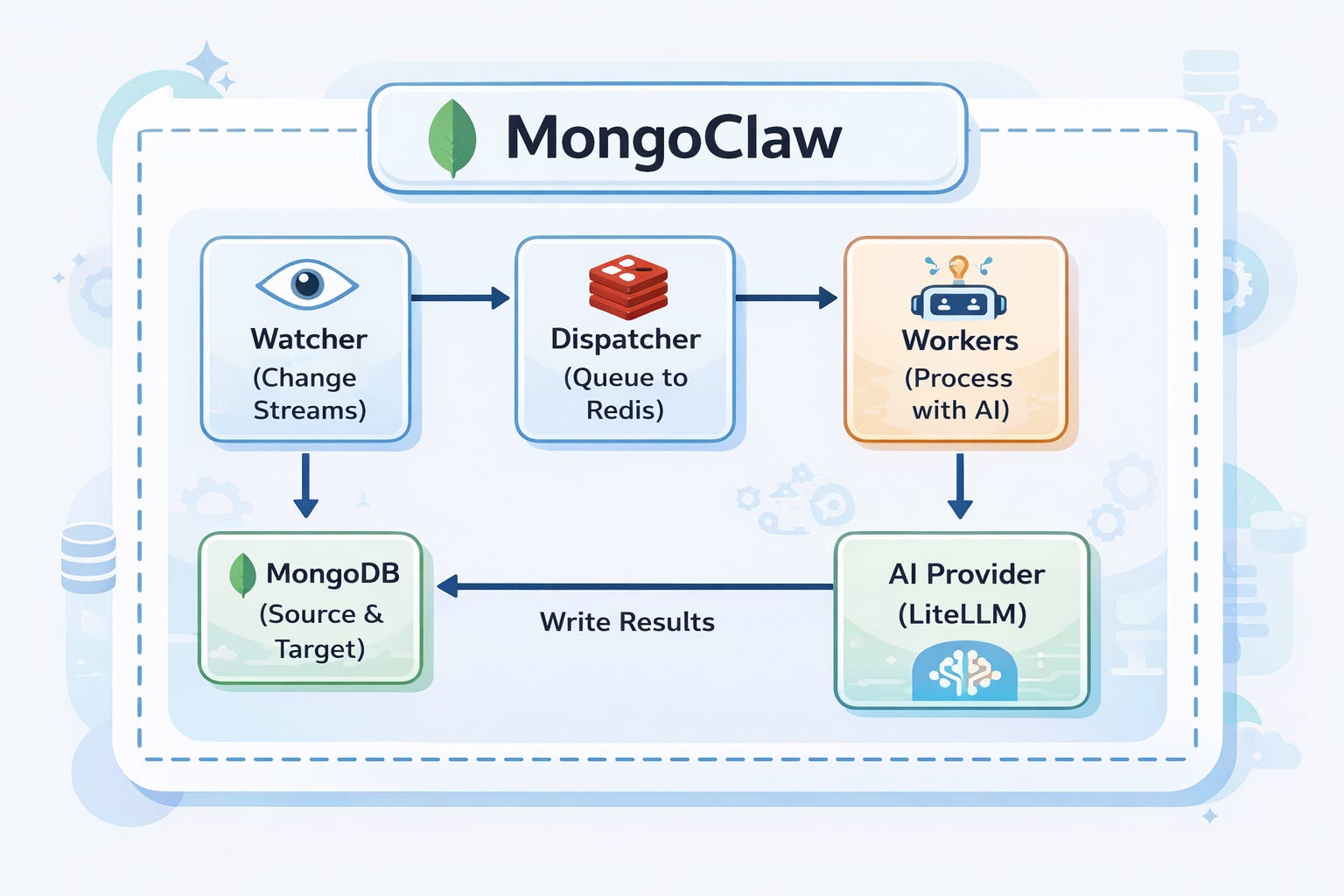
MongoClaw was designed for the team running 40 agents across 20 collections in production not the team running one agent in a weekend project.
Fair scheduling ensures no single high-volume collection starves every other agent stream. Work is distributed equitably across all active agents.
Priority-aware backpressure when queue pressure rises, MongoClaw evaluates each incoming work item against a priority threshold. High-priority work bypasses the pressure. Low-priority work is deferred, dropped, or dead-lettered. Configurable. Observable. Every admission decision metered.
Per-agent failure budgets with automatic quarantine. One broken agent wrong model, bad prompt, provider degraded does not drag down your entire worker pool. The agent gets quarantined. The rest of the system keeps running.
Circuit breakers per AI agent provider. When your upstream model provider is degraded, the circuit opens. You stop burning retries. You stop accumulating costs. You surface the problem instead of hiding it.
Routing strategies for horizontal scale by_agent, by_collection, partitioned, by_priority. Multiple pods. Coordinated via leader election. Crash-safe via persisted resume tokens. Picks up exactly where it left off.
External Agents. Same Guarantees.
Already have an AI agent service you’ve built internally? A third-party enrichment endpoint? MongoClaw treats external agent endpoints as first-class providers normalising heterogeneous response formats into a unified execution contract.
All the same write semantics apply. All the same policy enforcement applies. All the same idempotency and stale-write suppression applies. All the same execution records are emitted.
Your existing AI agents get MongoClaw’s safety guarantees without being rewritten.
Four Interfaces. Zero Compromise.
CLI for operators. REST for automation. Python SDK for Python applications. Node SDK for TypeScript teams. Same agent model. Same execution guarantees. Same audit records. Across all four.
This is not four separate integrations maintained in parallel. It is one runtime with four entry points.
This Is What Production AI Agents Actually Look Like
The industry is in an early and dangerous phase. AI agents are being dropped into production systems with the same casual trust we once gave to raw SQL strings and the incidents are starting to follow.
MongoClaw is the infrastructure response to that problem.
Deterministic stale-write suppression. Idempotent replay protection. Policy-governed mutation enforcement. Audit-grade execution records. Enterprise-scale queue controls. External agent interoperability. All of it, in a single declarative runtime.
This is not enrichment tooling. This is an execution control plane for AI agents on operational data.
The teams that build on this foundation will move faster, break less, and earn the trust of the enterprises they sell to.
Everyone else will keep debugging at 3am.
Open source. MIT licence.
pip install mongoclaw      # Python SDK + CLI
npm install mongoclaw # Node.js / TypeScript SDK
GitHub → supreeth-ravi/mongoclaw
A Clawbot army for every collection.